September 14, 2026
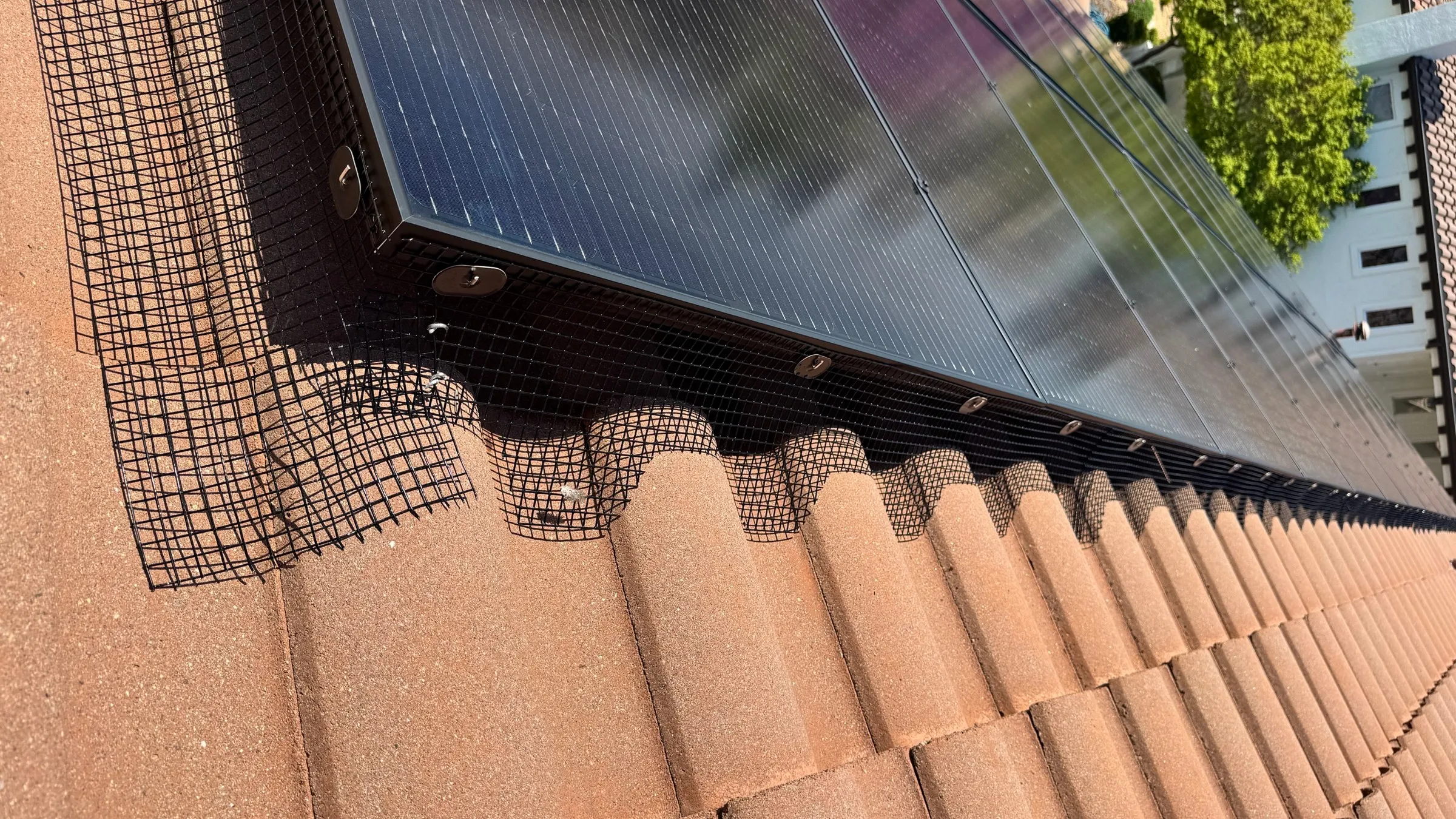
We get called out to failed bird proofing about once a week. Almost none of it is salvageable.
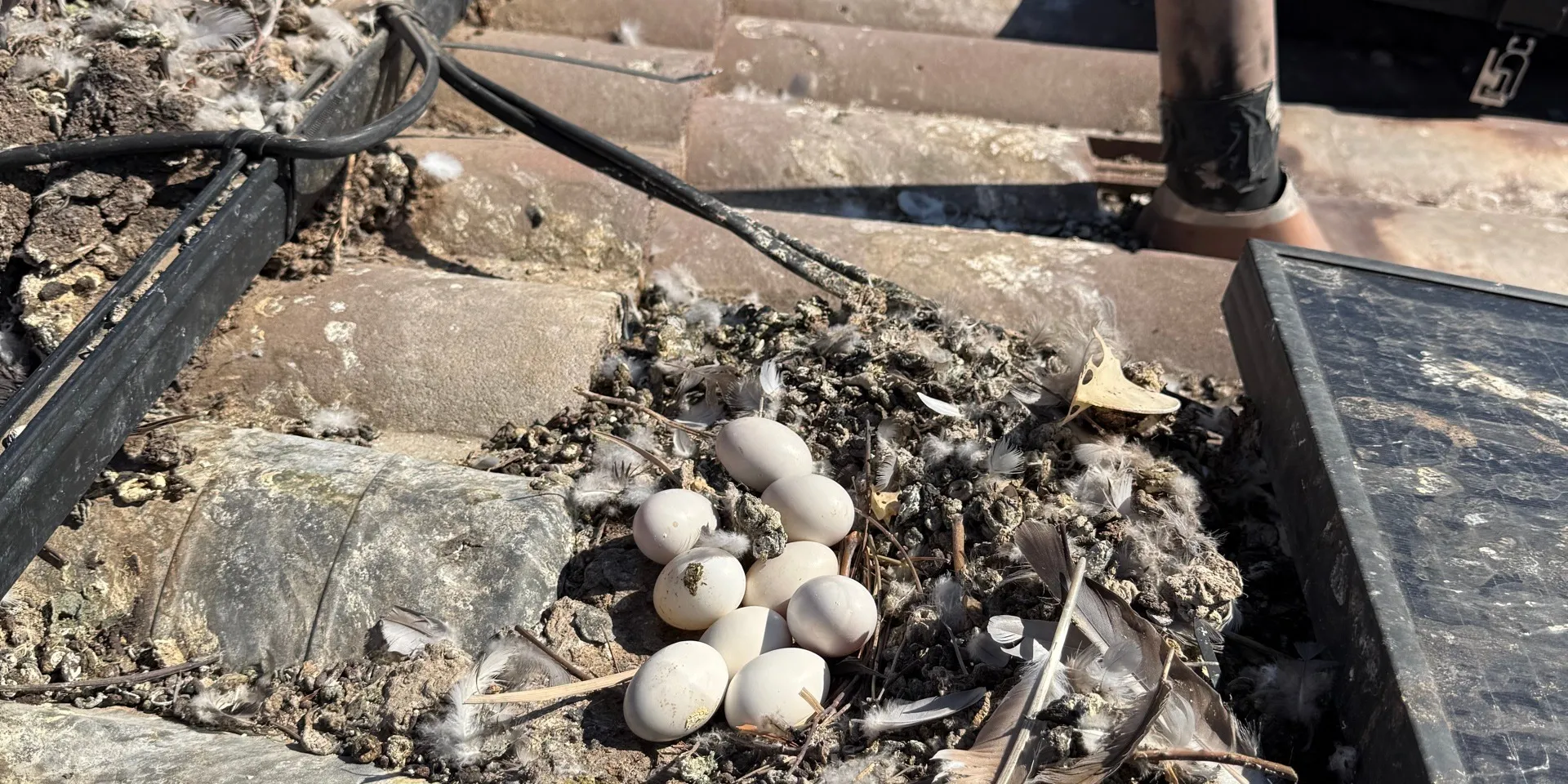
By the time someone calls, pigeons have usually breached the mesh, moved back under the panels and built up serious nesting again. The whole guard has to come off so the nesting can be removed and the roof cleaned, before new material goes on. The homeowner pays twice for a job that should have been done once.
The material is nearly always the reason. Here is what should go on your roof, and what typically goes on instead.
The spec that actually works
Solar bird proofing that lasts the life of a system is 1.5 mm or thicker, hot-dipped galvanized steel mesh with a PVC coating.
Each part of that matters:
- 1.5 mm or thicker. Enough strength that a determined pigeon cannot work an opening in it.
- Hot-dipped galvanized. The steel is dipped so the zinc coating is thick and bonded, including at cut edges where corrosion normally starts.
- PVC coated by dipping. A genuinely thick protective layer over the galvanizing, not a surface finish.
That combination is what allows anyone to offer a real guarantee. Nothing below it does.
Problem one: materials that were never meant for this
Before the cheap mesh conversation, there is a stranger problem. A lot of what we take off roofs was never intended for bird exclusion at all.
We have removed roofing material, offcuts of pipe, timber cut to fit, assorted contractor stock and bird spikes pressed into service as a barrier.
Here is the part that surprises people: most of that costs more than the correct product line, not less. Nobody saved money. Someone simply did not know what the right material was, improvised with what was on the truck, and the homeowner inherited it.
This is an education problem rather than a cost problem, which is why it keeps happening.
Problem two: the three ways corners get cut
The knock-off market is more deliberate. There is a great deal of generic mesh sold through online marketplaces, bought by companies competing purely on installation price, and it is cheapened in three specific ways.
1. Dropping the galvanizing
The simplest saving is to use steel that has not been galvanized at all. It looks near enough identical on day one. It behaves nothing like galvanized steel by year two.
2. Cutting the thickness
This is the big one, and the hardest for a homeowner to see.
Proper mesh is 1.5 mm or above. Cheapened mesh runs as thin as 0.3 mm. That is roughly one fifth of the material, sold to do the same job against the same birds.
It is the single most common way installation costs get cut, and it is the most dangerous, because the homeowner is expecting a permanent result from something that cannot deliver one.
3. Spraying the PVC instead of dipping it
Correct PVC coating means the mesh is dipped, building a thick black protective layer. The shortcut is to spray a thin coat instead. It looks the same on the shelf and it costs a fraction.
The consequence arrives later: thin coating means the steel underneath is exposed sooner, and the mesh rusts out and needs replacing.
There is a pattern with the companies buying this material. They compete on having the lowest installation price, they are vague about warranties, and a number of them are no longer trading by the time a customer tries to claim.
What failure actually looks like
Cheapened mesh tends to reach the same outcome on the same timeline: breach within two to three years.
It is rarely a dramatic failure. The material thins, corrodes or loosens at a weak point, a pigeon works at that point, and once one bird is through the colony follows. From the ground everything looks fine. The evidence is above you, accumulating.
The second job always costs more than the first, because it includes removal, nest clearance and roof cleaning before any new material can go on.
Installation faults that have nothing to do with material
Good material fitted badly fails too. Four mistakes come up repeatedly.
Drilling into the panels
Some installers fasten directly into the solar panels. This is the worst thing on the list. It voids the panel manufacturer’s warranty the moment they find out, and a panel warranty is worth considerably more than the bird proofing job.
Nothing should ever penetrate your panels. We fasten with J-hooks that clip to the panel frame itself, so nothing is drilled into the panels, the racking or the roof.
The wrong guard size
Solar arrays sit at different heights above the roof, and the mesh has to match. We see 6 inch material fitted where the standoff is 8 inch, and 8 inch fitted where it is 10 inch.
An undersized guard leaves a gap. A gap is an entrance. The job looks finished and the birds are back.
Straight mesh on a curved tile roof
Spanish style concrete tile is not flat. Running standard straight-line mesh along it leaves a row of openings under every tile curve.
Tile roofs need mesh cut to the tile profile. It takes longer, which is precisely why it gets skipped.
Mesh over the panel itself, or fasteners through the wiring
Bird proofing belongs at the edge of the array, sealing the gap underneath. It should never sit across the face of a panel, where it shades production cells and costs you output every day it stays there.
The same carelessness shows up below the panels, where fasteners driven without care can damage the system wiring. That turns a bird job into an electrical fault.
Why we manufacture our own
We got tired of the gap between what the job needs and what was available to buy.
Golden Rays now produces its own line of solar critter guard, and we supply it to a handful of local installers so their customers get material that holds up. It has the longest service lifespan we know of in this trade.
When our own crews install it, it carries a permanent lifetime guarantee, covering your system for as long as the system lasts, which on modern panels is comfortably 25 years or more.
That guarantee is only possible because of the material. No company can responsibly warrant 0.3 mm ungalvanized mesh for 25 years, which is why the ones using it either offer one to five years or avoid the subject.
Will it affect performance or how the roof looks?
These are the two questions homeowners ask most, and both have the same answer: done properly, no. Done badly, yes, and in ways that cost you.
Airflow and panel temperature
Correct mesh, correctly installed, is specifically designed not to interrupt airflow or affect panel temperature. It seals the gap birds use without closing off the ventilation your panels rely on.
That only holds when both halves are right. The wrong material, or the right material fitted badly, is where you get genuinely blocked airflow, mesh sitting over production cells, and fasteners damaging wiring. Every one of those is an installation failure rather than something inherent to bird proofing.
Appearance
Our critter guard has an all black finish and goes on uniform, so it reads as part of the array rather than something added to it. Fitted properly it tidies the edge of the system and keeps the anchors discreet. Most homeowners think the roof looks better afterwards.
Fitted badly it does the opposite. It makes future solar panel cleaning harder, it cheapens the look of the roof, and worst of all it carries on letting pigeons under your panels.
That is the part worth holding on to: the installation that looks wrong from the driveway is usually the same one still failing at its actual job.
How to check before you buy
Four questions will tell you most of what you need:
- What thickness is the mesh? You want 1.5 mm or greater. If nobody can tell you the number, that is your answer.
- Is it hot-dipped galvanized, and is the PVC dipped or sprayed? Both matter, and a real installer knows which theirs is.
- How will it be fastened? Anything that penetrates your panels should end the conversation.
- What does the warranty cover, and who backs it? A long warranty from a company with no track record is not a warranty.
Get it done once
We install solar bird proofing across Fresno, Clovis, Madera and the Central Valley, and we are certified through Bird-B-Gone and Bird Barrier.
If you already have mesh that is failing, or you want it done properly the first time, book a free inspection and we will show you photos of what is actually under your panels. You can also read more about our solar bird proofing service.